
10 UX Design Principles Every Marketer Should Know
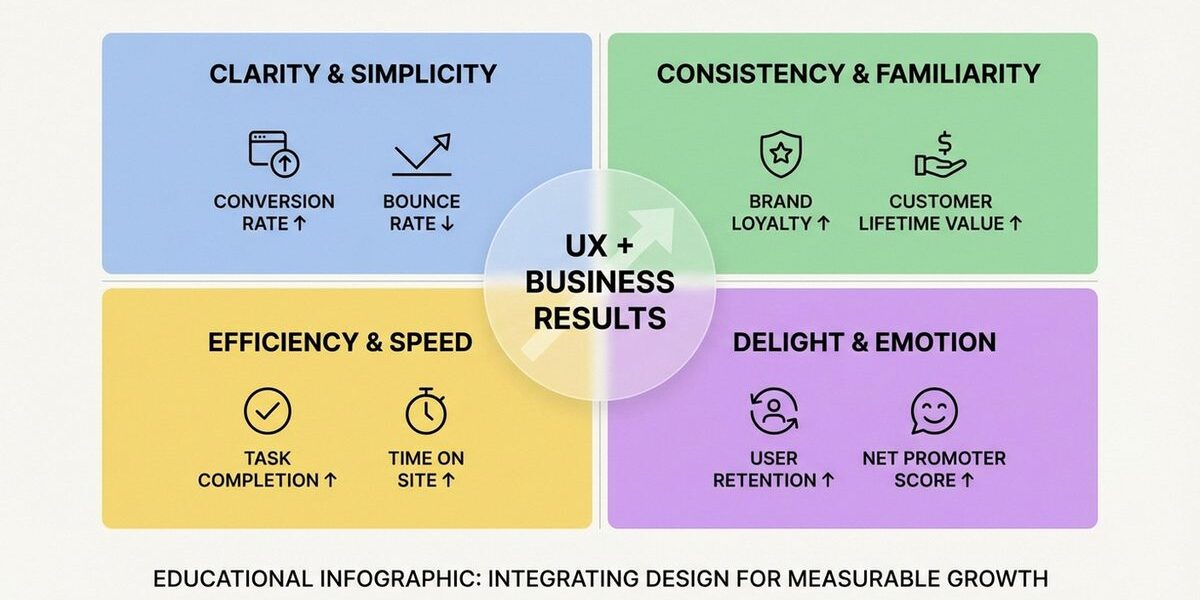
You don’t need to be a designer to benefit from understanding UX principles. These ten concepts will change how you think about marketing, landing pages, email campaigns, and every other touchpoint where your audience interacts with your brand.
1. Hick’s Law: Fewer Choices, Faster Decisions
The time it takes to make a decision increases with the number of options. Your landing page with twelve CTAs? It’s paralyzing your visitors. Reduce choices to accelerate action.
2. Fitts’s Law: Make Targets Easy to Hit
The time to reach a target is a function of its size and distance. In practice: make your buttons big enough and put them where people expect them. Mobile CTAs that require precision tapping are conversion killers.
3. Jakob’s Law: Users Spend Most Time on Other Sites
People expect your site to work like the sites they already know. Innovation in navigation patterns isn’t creative — it’s confusing. Follow conventions unless you have an exceptional reason not to.
4. The Peak-End Rule
People judge experiences based on the peak moment and the final moment, not the average. Design your user journeys with a memorable high point and a satisfying conclusion.
5. Cognitive Load
Working memory is limited. Every element on your page that requires processing — text, images, animations, choices — consumes cognitive resources. Reduce load by eliminating non-essential elements.
6. The Von Restorff Effect
The item that stands out is the item that gets remembered. Use visual contrast deliberately to highlight your most important elements. If everything is emphasised, nothing is.
7. Progressive Disclosure
Show only what’s needed at each step. Don’t overwhelm users with information they don’t need yet. Reveal complexity gradually as users demonstrate readiness.
8. Social Proof
People follow the behaviour of others, especially in uncertain situations. Reviews, testimonials, user counts, and case studies reduce decision anxiety and increase conversion.
9. The Aesthetic-Usability Effect
Users perceive attractive designs as more usable, even if they’re not. First impressions matter — invest in visual polish because it directly affects perceived functionality and trust.
10. Feedback Loops
Every action should have a visible response. Button clicks, form submissions, loading states — without feedback, users are uncertain whether their action registered. Uncertainty breeds abandonment.
Applying These Principles
You don’t need to redesign everything. Start by auditing your highest-traffic pages against these principles. The gaps you find will often explain the conversion problems your analytics have been showing you.
Keep Reading
If UX thinking interests you, see how it plays out in practice in Why the Best Campaigns Start With User Research. For hands-on guidance, our Beginner’s Guide to CRO covers conversion optimisation from a user-centred perspective.